

Did you know that indie romance authors are expected to produce a new book every quarter? On one hand, I am glad that the romance genre is growing at an exponential rate, but on the other hand, I am both saddened and alarmed at the hypercapitalist environment authors are forced to work in. Authors are not robots, and we have the same needs as everyone else. As creatives, authors should be prioritizing self-care and healthy boundaries, but instead, we are forced to work more for less.
But a lot of the time, it feels like we don’t commit ourselves to producing book after book in rapid succession, so we will not be able to make a living. As much as I despise the use of AI-generated books and AI-generated art. I do understand why some authors are tempted to use it. Because the obligations and expectations of authors are only growing, and authors mistakenly think they need to generate books to keep up.
This is why a lot of new authors don’t make it past their third book because the pressure to produce books takes both a financial and mental toll. And it’s not just indies. Traditionally published authors are often forced to produce more and finance their own marketing out of their own pocket, while the publisher takes the lion’s share of the royalties.
In 2023, shortly after publishing my last book, Splinter. I had a breakdown. I was so burnt out that it took me two years to recover. I had the sudden epiphany that if the publishing will chew me up and spit me out of it, I’ll let it. I knew then that I had to slow down and find a method that prioritized self-care. And I’m going to give you some tips that have helped me get to a better mental place without me having to sacrifice my dreams of being an author.
Rest Is Resistance
People underestimate the power of rest. In our late-stage capitalist hellscape, people are expected to work 24/7 to make a living. And our productivity becomes a symbol of our worth. This is why prioritizing rest is more important now than ever. Rest, taking breaks from the need to monetize things, finding times to slow down and find happiness in the everyday joys, and hell, even taking a nap once in a while.
The idea of rest is subjective to everyone, especially if you are neurodivergent. Do you know that not only are there 7 forms of rest, but neurodivergent people need to rest differently than neurotypicals? According to Psychology Today, the seven forms of rest are
- Physical Rest
- Mental Rest
- Emotional Rest
- Social Rest
- Sensory Rest
- Creative Rest
And if you are neurodivergent, rest is that much harder. I have ADHD, and my brain is like a hyperactive squirrel. It never stops running. I had to do more research about it, and I am going to show you two very helpful videos on the subject.
Let’s also talk about the elephant in the room: race. Before you ask why I must bring race into this, it is because BIPOC have a different relationship to race than white people. BIPOC (especially BIPOC women) are socialized to not only work all the time but also to work ten times harder. I am going to recommend a book that changed my life. And I don’t say that lightly.
The book ‘Rest Is Resistance’ by Tricia Hersey talks about labor and rest from a Black woman’s perspective and how rest in a hyper-capitalist world is resistance.
Now we know what rest is. I think it’s time to give you more tools that you need for your author self-care tool kit.
Self-Care Hacks For Authors
1) Having Office Hours
The dream for a lot of aspiring writers is to be a full-time author. However, as much as people love to glamorize the work-from-home lifestyle, people don’t talk about the downsides of it. And one of them is the guilt that comes with it. Working at home is a privilege, and with that privilege, many authors think they need to not only work 24/7 but also be available at all hours.
This is a quick way to burn yourself out. This is the time to think about what times during the day (or night) you are the most productive, what days off you want, and how you want to implement a healthy work/life balance. I found out that organically I only need to write 4 days a week with a daily word count goal of 2-3k words, and that I don’t do well with consecutive days off, so I work two days, and I take off Thursday and Sundays. My work hours are from 6 am to 5 pm.
Find what works for you and stick with it. It’s not about writing every day; it’s about finding a consistent schedule that works for you and your life.
2) Social Media Boundaries
The line between author spaces and readers is eroding by the day. As a result, this has made a lot of drama for both sections of the book community. You need to think hard about what your boundaries on social media are going to be. The questions you need to ask yourself
- What behavior is a blockable offense?
- Do you want negative reviews? And if you don’t, are 3-star reviews okay?
- Will you put your children’s faces on the internet? What about your partners?
- What will you and will not discuss about your personal life?
- How political are you willing to get?
- Will you show your face or not?
- Will you share your location (City, State, Region) where you live?
- Will you take DMs from anybody or just your friends?
3) No more than 3 social media platforms
You are going to be tempted to use all of the social media platforms. But not every platform is a great fit for everyone. I had to leave TikTok because I found that platform mentally draining. When you are first starting, I recommend you pick no more than 3 platforms. And don’t hesitate to take a moment to think about your feelings about each one and if you fit with that platform.
Always re-evaluate if you are happy with the platforms you are on. The book community is vast, and you will find your audience no matter the platform.
4) Stay Away From Your Reviews
I have been an author for six years, and I have never read a review. I know myself; I’m too tender to be able to read my reviews without acting a fool. And so I made a promise to myself from the very beginning to never read my reviews. Instead, I save every good comment, email, or book recommendation I have been tagged in and put them in a folder.
And if I need validation, I scroll through that folder. A lot of authors are seeking validation from their readers via reviews. And that is not what reviews are for. They are a consumer tool for our customers (aka our readers). Reviews are for readers. I want you to think hard and long about whether you are mentally strong enough to go through your reviews without getting up in your feelings.
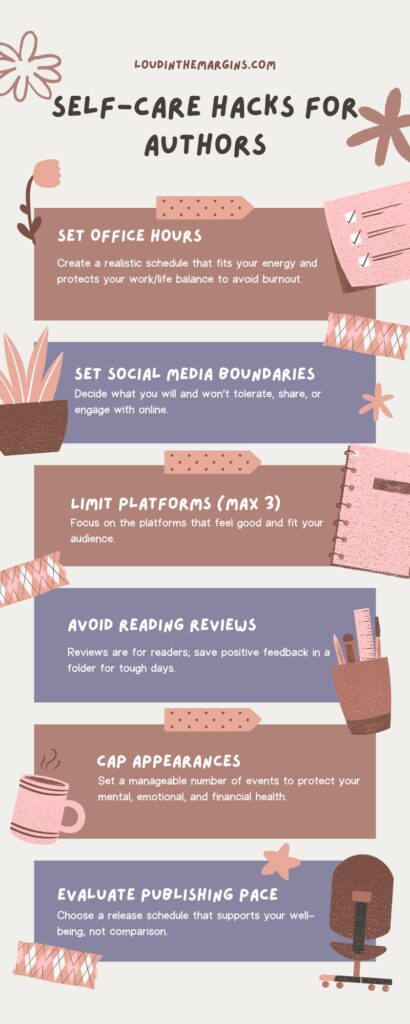
5) Have a set number of appearances
I have seen way too many authors (both new and old) wear themselves out doing all the in-real-life appearances (especially in the summer). And let me tell you, I know for a fact that doing that many appearances can take a mental, emotional, and financial toll. Sit down and think about the number of appearances you can do, and you can afford it.
We all suffer from Fear of Missing Out (FOMO), but you have to have perspective. A lot of us want a long career, and doing a lot of real-life appearances as an author can burn you out.
6) Evaluate your publishing pace and if it’s right for you
Some authors publish 8 to 12 books a year, and some authors publish only 2 or 3. Having a quicker or slower publishing space does not make you less of an author. This is the time to think about your workload now and see if you can slow down or speed up. As I said earlier, your first instinct is to compare yourself to others in your niche or genre.
But doing that is going to push you to publish more or less than you are mentally capable of. You should always be asking yourself if your publishing schedule is working for you. And this is also the time in which you are honest with your readers. If you explain to your readers what is going on, most of them will understand. Yes, some entitled readers expect you to risk your mental health to publish a book.
Thankfully, readers know that you are human and that waiting will result in both a better book and a happier author.
7) Give Yourself Grace
If there is one message I want you to get from this post, it is that you are human and that is okay. Most readers don’t want a robot to generate a book for them. They want a book written by a real human person. And real humans need things like rest and self-care to create the best work. Stop the comparison game and give yourself grace.
You are human, and sometimes you are going to mess up. The only thing that matters is that you learn from your mistakes and try again.
And those are my tips for self-care for authors. I hope you got some self-care tips that will make your author life so much easier. Now I want to hear from you! What do you do for self-care as a writer? Let me know down in the comments.
PIN THIS


Discover more from Loud In The Margins
Subscribe to get the latest posts sent to your email.




Leave a Comment