

When I say the phrase “Fear of Missing Out” or FOMO, most people groan. For a lot of people, FOMO is peak millennial nonsense. And within the publishing sphere, people think that they are immune to it. Surely authors don’t suffer from FOMO, right? We are supposed to be above that, and we leave this type of nonsense to desperate millennials and Gen Z folks who are willing to spend their entire life savings on a pipe dream.
However, for me, this type of behavior is not just something that happens at Fyre Fest (and if you haven’t seen the two documentaries on that, you should because it shows the folly of giving into FOMO), but it’s ending careers and leaving authors in a pile of debt. This disproportionately affects self-published authors, but we are expected not to talk about it. Every time authors give in to the fear of missing out, we are expected to just quietly swallow the loss and keep it moving.
But I don’t believe in that at all! I think to make the publishing ecosystem a safer and more just place, we must put a spotlight on the problems that are harming authors, now more than ever. This is why I am breaking down why FOMO harms authors and what we can do to make sure that we can avoid the pitfalls of jumping on trends for the sake of a possibility of success.
But first, we need to break down exactly what Fear of Missing Out is.
What Is FOMO?
According to Merriam-Webster, the term is the “fear of not being included in something (such as an interesting or enjoyable activity) that others are experiencing.”
Fear of Missing Out can be expressed and experienced in a myriad of ways. And it’s something that is not only affecting influencers who are willing to sell their right lung to go to Coachella or someone missing out on the hot new TV show or movie. The truth is that a lot of us give in to Fear of Missing Out every day. According to a study by OnePoll, over %69 Americans experience FOMO in their lives.
People think that FOMO is new, but this is an old marketing tactic. You give a customer a sense of false scarcity, and then you make it look like everyone who is cool is doing that thing or wearing that. Hell, this is basically the point of trends. It’s to create a fear of missing out and then exploit that to make them participate or discuss a trend.
Most of the time, this type of behavior is harmless. From talking about the hot new movie to deciding to wear a trendy new dress. People can argue that Booktok is notorious for setting trends and using FOMO to sell books. And no, this is not me crapping on Booktok, but as someone with a modicum of marketing knowledge (I’m not an expert), I can see the patterns in my community.
However, people take it too far. It’s one thing to recommend a book, but when are we encouraged to buy every special edition or to buy stacks of expensive books from Barnes and Noble? This can take a toll on your pocketbook and on your mental health. The book community has an overconsumption problem, and we are still struggling with how to balance enthusiasm for books and the compulsion to buy all the books.
But how does having a fear of missing out affect authors?
The Harm of FOMO for Authors
Everyone experiences a fear of missing out occasionally. This is natural, but when it comes to being an author, especially an indie author, we are expected to do everything ourselves. We have to be a writer, a marketer, a business person, an editor, and a formatter all at once. Now, if you are successful enough, you can outsource some of that to a virtual assistant, but most of the time? Indie authors are doing all of that themselves.
And then add on top that they desperately need to succeed, that never quite leaves us. We are constantly forced by the growing, dire social and economic circumstances and readers’ expectations to constantly grind and to bleed both our mental health and your pockets dry to make a living wage. A lot of us would love to give up our day jobs and become full-time writers.
But what a lot of people don’t understand is that this happens for only a few of us because the publishing sphere rewards white people with wealth the most. The self-publishing community has always had a rabid classism problem. And that this type of desperation to succeed at all costs can brew a toxic mixture of grind culture and a fear of missing out. And when that happens, authors can lose their ability to discern between a true opportunity for growth and a money pit.
The result of this is that authors are rushing to publish or to release special editions they are not financially or mentally ready to put real effort into. Another way I have seen this play out is that people are doing huge marketing campaigns on platforms such as Kickstarter with no knowledge of how to run a successful campaign that leaves their readers satisfied. These authors will quickly get overwhelmed and then end up either dropping the campaign altogether or never giving readers the rewards they pay out.
The biggest example of this is Britt Andrews and Milo Winter. They were so busy tracing trends of making special editions that they ended up betraying the trust of their readers.
Let’s be honest, is producing audiobooks expensive? Then producing a special edition is just as expensive, if not more. You can spend a good $10,000 easily if you are not careful. And being an author is already expensive, and if you are a traditional author, you will probably be expected to spend money on marketing costs out of your own pocket.
But you just had to make a special edition because all of your favorite authors are making one.
Another way a FOMO can be expressed in the author community is when authors write trends they have zero interest in or passion. Yes, writing to market is the backbone of the book community. As professional authors, we often must put the needs and the wants of readers over what we want sometimes.
But writing a trope or a niche you hate for money? Yeah, that is going to bite you in the ass eventually.
The reason I say this is that readers, in particular romance readers, are very discerning. People like to snub their nose at the ‘Booktok girlies’ or romance in general. And if you would only pay attention to the big booktok influencers, you would think you can literally wrap up crap in a book, and we would rave on it.
But those people who think about the romance genre in this way are only seeing a small part of the book community. The book community is larger than BookTok, and book readers can immediately clock when the author is just painting a book by numbers. This is why, even though due to Heated Rivalry, hockey books are flying off the shelves, I will never write a hockey romance because I hate hockey.
It’s just not my thing, and I refuse to pretend otherwise for cash.
However, there are authors who will send a trend they despise and only see dollar signs. And before you get it twisted, I am not saying don’t write to market or participate in trends. Sometimes, doing that can be a good thing for both the author and their readers. But what I am saying is that you have to truly put thought into the trends you participate in.
Authors are business owners, and I think that point gets lost a lot. We have to consider things not only as artists and creatives but also as businesspeople. You have to wear both hats, and as a business person, you need to have not only the ability to pivot at a drop of a hat but also the discernment to tell if participating in a trend is right for your business.
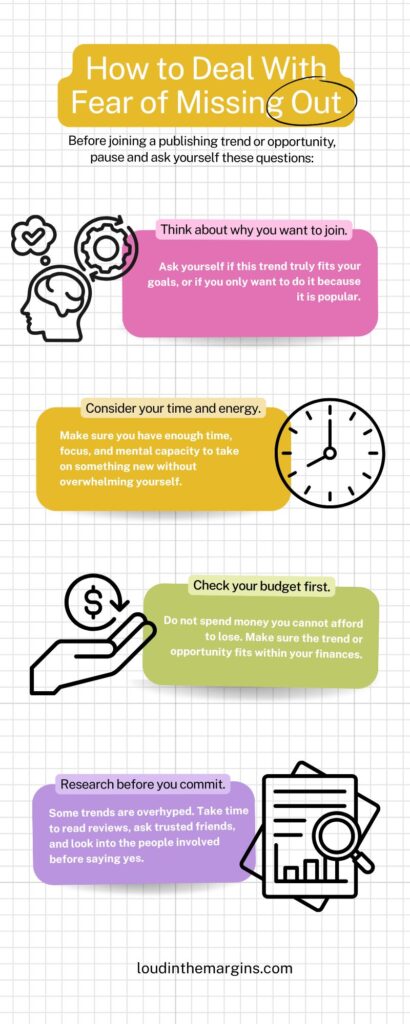
How to Deal With Fear of Missing Out
Before you jump on a publishing opportunity or a book trend, take a moment to ask yourself these questions.
1. Think About Why You Want to Participate In The Trend
Do you really want to do the popular thing, or do you want to do it because it’s cool? Sometimes, we do things only because it’s popular, even though it doesn’t vibe with us. Sit down and really think about whether you want to participate in this trend before jumping in headfirst.
2. Consider If You Have The Time or Mental capacity to do this.
I know that this looks fun, but take a moment to think about your schedule. Do you have time to devote to joining in this trend? Will this make you sacrifice more than you are willing to? Do you have the spoons to tackle this task for the long term?
3. Can you do this without going into debt?
This is the most important thing to think about when considering participating in a trend. Can you even afford to do this? Let’s be honest, the world is currently in a severe depression, and everyone is tightening their belts these days. Can you afford to spend any money right now? How does joining in on this trend fit within your budget?
4. Is this trend overhyped for no reason?
I am going to circle back to the Fyre Fest example. Fyre Fest was purposely overhyped by Billy McFarland and Ja Rule, but red flags were there from the very beginning. There was even a Twitter account dedicated to pointing out those red flags, but a lot of people refused to do their due diligence and listen. And this is not me victim-blaming. They didn’t deserve to be trapped on an island with little food or water. But I am just pointing out that an ounce of prevention is worth a pound of cure.
Before pulling out your credit card, take a moment to do some research and ask for opinions from friends. This is the time to drop this trend or opportunity in the author group chat. Get to googling everyone involved in this trend or opportunity. Five minutes of googling can save you from a world of hurt.
Now you know about FOMO and how to cope with a fear of missing out you can go out and be a better author without the unneeded stress. Do you deal with FOMO? And how do you deal with it? Let me know down in the comments.
Pin This

Discover more from Loud In The Margins
Subscribe to get the latest posts sent to your email.




Leave a Comment